
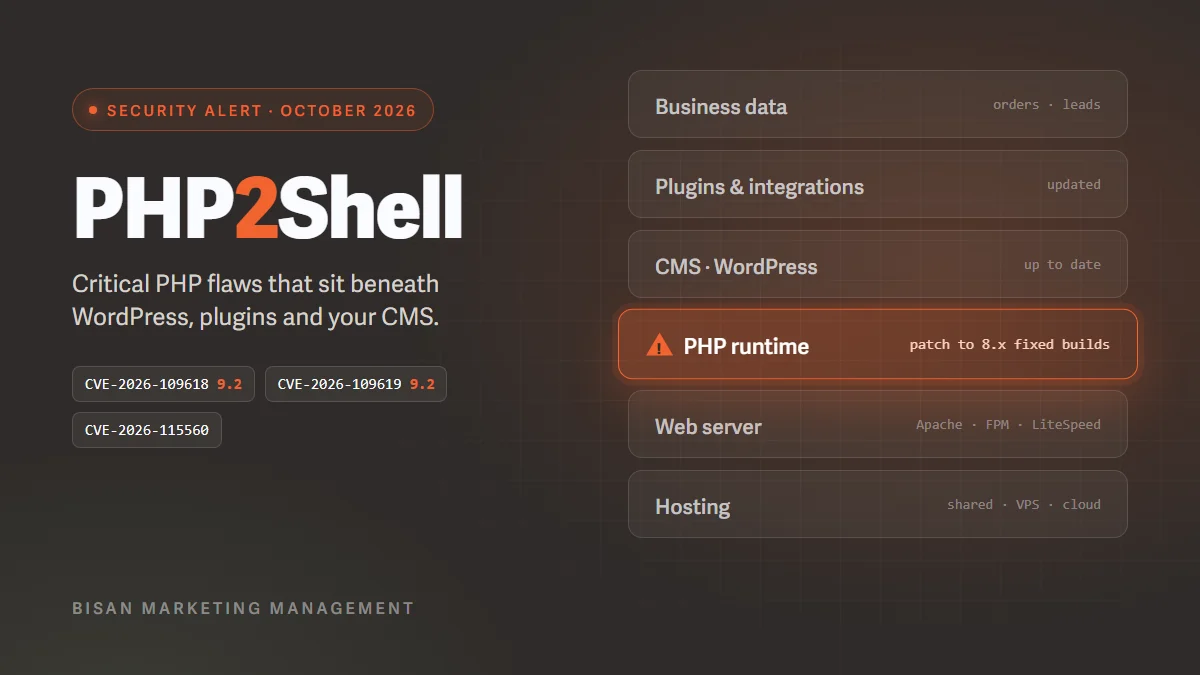
A critical security flaw does not always begin with a suspicious WordPress plugin, a weak password, or an outdated website. Sometimes, the vulnerability exists much deeper—in the programming language powering the website itself.
On October 21, 2026, the PHP development team released emergency security updates addressing two critical vulnerabilities, CVE-2026-109618 and CVE-2026-109619, collectively known as PHP2Shell.
Both vulnerabilities received a critical severity score of 9.2 out of 10 under CVSS v4.0. Under certain conditions, they allow attackers to execute malicious code on vulnerable servers without authentication.
The implications extend far beyond individual websites. PHP powers major content management systems, e-commerce platforms, business applications, and custom web services.
For businesses relying on their websites to generate leads, process transactions, or communicate with customers, the incident raises an important question:
How secure is your website when a vulnerability exists beneath the application itself?
This analysis examines what happened, how the vulnerabilities work, which websites are affected, what security researchers have observed, and what businesses should do to reduce their exposure.
What Is PHP2Shell?
PHP2Shell is the name commonly used for two related vulnerabilities in PHP's internal request-processing and memory-management systems.
PHP is a server-side programming language. When someone visits a PHP-powered website, the server executes PHP code to retrieve information, process requests, interact with databases, and generate the page the visitor sees.
The vulnerabilities affect how PHP handles certain errors and manages memory during that process.
Both can potentially result in Remote Code Execution (RCE), which means an attacker may be able to run commands on a vulnerable server.
More importantly, the attacks do not necessarily require the attacker to log in to the website.
This distinguishes PHP2Shell from many familiar WordPress attacks, where attackers typically exploit a vulnerable plugin, theme, or application feature.
PHP2Shell affects the underlying PHP runtime.
As a result, updating WordPress plugins alone cannot resolve the vulnerabilities.
The official PHP security advisory identifies several potentially affected server environments, including PHP-FPM, Apache with mod_php, php-cgi, FrankenPHP, and LiteSpeed.
The Two Critical PHP Vulnerabilities Explained
Although the vulnerabilities are related, they exploit different weaknesses in PHP's internal handling of memory and application requests.
1. CVE-2026-109618: Memory Corruption During Out-of-Memory Errors
Severity: Critical — CVSS 9.2
The first vulnerability concerns how PHP responds when a request exceeds its memory allocation limit.
Normally, PHP restricts the memory available to individual requests. When a process exceeds the configured limit, PHP interrupts its execution to prevent excessive resource consumption.
However, researchers discovered that this interruption could happen while internal data structures were only partially initialized.
During subsequent cleanup, PHP could incorrectly interpret that incomplete data as valid memory.
This could create a memory-corruption condition that an attacker may exploit to execute malicious code.
The issue is particularly serious in Apache configurations using mod_php, where researchers demonstrated that an unauthenticated HTTP request could trigger the vulnerability before application-level code begins executing.
In practical terms, this means application-level protections might not get an opportunity to inspect or reject the malicious request before the vulnerable operation occurs.
The technical details are documented in the official CVE-2026-109618 security advisory .
2. CVE-2026-109619: Reusing Memory After It Has Been Released
Severity: Critical — CVSS 9.2
The second vulnerability involves stale internal state and a memory-safety issue known as use-after-free.
PHP workers process requests while maintaining certain internal structures.
Some of these structures reference memory that belongs to an individual request and should be reset before that memory is released.
Researchers discovered that specific errors could interrupt this cleanup process.
Consequently, a later request handled by the same worker could access memory that had already been freed.
Under carefully controlled conditions, an attacker could manipulate this behaviour to trigger remote code execution.
The attack is technically complex and depends on factors such as PHP configuration, worker behaviour, and request-processing conditions.
Nevertheless, researchers demonstrated viable exploitation paths, including attacks involving session upload progress and error-handling behaviour.
The official CVE-2026-109619 advisory provides further technical details.
Which PHP Versions Are Affected?
On October 21, 2026, the PHP development team released security updates for all four supported stable branches.
| PHP Branch | Vulnerable Versions | Security-Fixed Version |
|---|---|---|
| PHP 8.5 | Earlier than 8.5.12 | 8.5.12 |
| PHP 8.4 | Earlier than 8.4.27 | 8.4.27 |
| PHP 8.3 | Earlier than 8.3.36 | 8.3.36 |
| PHP 8.2 | Earlier than 8.2.35 | 8.2.35 |
| PHP 8.1 and older | End-of-life branches | Upgrade or obtain a verified vendor security backport |
These releases address CVE-2026-109618 and CVE-2026-109619.
Organizations using older PHP versions should not assume they are protected simply because their websites appear to function normally.
The PHP project no longer provides regular support for PHP 8.1 and earlier. Some enterprise Linux distributions and long-term-support vendors may offer backported security fixes, meaning a system can receive a patch without changing its upstream version number.
However, businesses must verify those fixes with their actual software or hosting provider.
There is also a longer-term consideration: PHP 8.2 reaches end of life on December 31, 2026. Websites running that branch should begin planning migration to a newer, supported release.
Source: PHP Supported Versions .
A Third Vulnerability Was Disclosed on October 23
The original PHP2Shell announcement was not the end of the story.
On October 23, the PHP team disclosed another potential remote code execution issue, identified as CVE-2026-115560.
This vulnerability is different from the original two.
According to PHP's advisory, exploitation requires an unusual combination of application configuration and behaviour.
Specifically, an application must initially configure session.serialize_handler as php_binary or php_serialize, change it to php at runtime before starting a session, and have PHP's session upload progress functionality enabled.
Applications that never change the session serialization handler at runtime are not exposed to this specific attack path.
Importantly, the October 21 PHP updates do not fix CVE-2026-115560.
The PHP team intends to address this issue in its next regular bug-fix release.
Until then, the official recommendation for potentially affected environments is to disable PHP's session upload progress feature:
session.upload_progress.enabled=0
This setting should be applied through the appropriate server-level configuration, with PHP workers restarted afterward.
For the original two vulnerabilities, configuration changes remain incomplete substitutes for patching.
The distinction matters: a website updated against the two critical PHP2Shell vulnerabilities may still require a configuration review for the newly disclosed issue.
Source: PHP Security Announcements, October 23 .
How Widespread Is the Risk?
The potential exposure is substantial.
In its October 2026 threat analysis, Palo Alto Networks' Unit 42 reported identifying more than 22.6 million internet-exposed instances potentially vulnerable to CVE-2026-109618 and CVE-2026-109619 through its Cortex Xpanse telemetry.
This number should be interpreted carefully.
It is an exposure estimate, not a verified count of compromised websites or even a definitive count of exploitable installations.
Actual exploitability depends on PHP versions, configurations, web-server architecture, and other technical conditions.
Still, the scale illustrates why a flaw in a widely deployed programming language can create a major security problem.
Unlike a vulnerability limited to one plugin or application, a weakness in a common runtime can affect many otherwise unrelated websites.
Source: Palo Alto Networks Unit 42 Threat Brief .
Have Attackers Actually Exploited PHP2Shell?
This question requires distinguishing between three different events:
These events are not interchangeable.
The vulnerabilities are demonstrably exploitable, and publicly available proof-of-concept material has increased the threat.
Amazon Threat Intelligence reported identifying a PHP2Shell exploitation attempt on October 17, 2026, four days before the official security updates became available.
Its monitoring systems subsequently recorded additional attempts on October 21, including activity before the coordinated patch release.
However, attempts detected against security monitoring infrastructure do not automatically establish that real-world systems were successfully compromised.
Initial reports from several security vendors also required correction.
On October 22, Sophos revised an earlier assessment suggesting successful exploitation, stating that further analysis showed scanning activity and unsuccessful attacks in the customer environments it had examined.
On October 25, Palo Alto Networks' Unit 42 similarly withdrew an earlier attribution of a government-related incident to PHP2Shell after determining that the initial access method could not be confirmed.
The Dutch National Cyber Security Centre also reported that exploitation appeared more complex than originally estimated, reducing the likelihood of widespread successful attacks.
As of October 26, 2026, there is credible evidence of real-world exploitation attempts, but the publicly available evidence does not establish widespread successful compromises.
That distinction should not be interpreted as a reason to delay patching.
A critical, technically demonstrable vulnerability remains a serious risk even when confirmed real-world compromises are limited or difficult to establish.
Sources: AWS Security Blog , Sophos Threat Research , and NCSC Netherlands .
Why WordPress and WooCommerce Websites Should Pay Attention
WordPress is one of the most recognizable platforms built with PHP.
WooCommerce, widely used to create online stores, also operates within the WordPress ecosystem.
Other PHP-based platforms, including Drupal, Joomla, Magento, and Laravel applications, may also depend on vulnerable PHP installations.
However, it is important to understand what the vulnerability does—and does not—mean.
PHP2Shell is not a vulnerability in WordPress itself.
The WordPress project explicitly confirmed on October 21 that no WordPress core update was required or planned to resolve these PHP vulnerabilities.
The affected component is the PHP runtime installed on the server.
Yet the website could still face exposure because its server is running an affected PHP version.
For WooCommerce stores, the potential consequences of server compromise may be especially serious because the infrastructure handles customer accounts, orders, and commercially sensitive information.
This does not mean the vulnerabilities automatically expose payment details or that every PHP-powered store is exploitable. The actual impact depends on how the application handles data, its security architecture, and the permissions available to a compromised server process.
Nevertheless, business owners should treat the PHP runtime as an essential part of their website's security.
Source: WordPress Official Security Announcement .
The Business Impact: Beyond Technical Security
The potential consequences of PHP2Shell are not limited to the technical team responsible for maintaining a server.
If an attacker successfully compromises a vulnerable website, the effects could spread across several areas of business operations.
1. Website Availability and Revenue
An attacker could potentially disrupt server operations, modify application files, or interfere with normal website functions.
For an online store, downtime can mean interrupted purchases and lost transactions.
For a lead-generation website , it can mean missed inquiries, inactive forms, and wasted advertising expenditure.
A marketing campaign may continue sending traffic to a website that is no longer capable of converting visitors into customers.
2. Data Confidentiality
Successful remote code execution could give attackers access to resources available to the compromised PHP process.
Depending on server permissions and architecture, these resources might include application files, environment variables, database connection credentials, or sensitive business information.
The degree of access would depend on the specific deployment.
This is why least-privilege access controls and properly separated infrastructure remain important even after security updates.
3. SEO and Search Visibility
Security incidents can also create secondary SEO risks.
If attackers modify website content, insert spam pages, create malicious redirects, or distribute harmful files, search engines may detect the compromised material.
Such incidents can lead to search warnings, indexing problems, and reduced user trust.
Website downtime and technical instability may also affect crawling and the ability of visitors to access important pages.
However, the existence of a PHP vulnerability does not automatically cause a Google ranking penalty.
The SEO consequences depend on whether a compromise occurs and whether it affects the website's availability, content, or search engine accessibility.
4. Brand Reputation
Customers rarely distinguish between a compromised plugin, a hosting vulnerability, or an application-level security failure.
They experience the outcome.
A security warning, unauthorized redirect, inaccessible checkout, or unexpected website behaviour can damage confidence in the business itself.
For companies that invest heavily in digital advertising, branding , and customer acquisition, website security is therefore closely connected to their commercial performance.
Why Did This Vulnerability Take So Long to Fix?
One of the most important aspects of the PHP2Shell incident is its development history.
According to an October 21 statement from the PHP Foundation, the first signs of the underlying out-of-memory issue were identified in 2024 during work connected to a security audit.
At that time, the possibility of exploitation was recognized, but researchers had not identified a concrete attack path.
Addressing the problem also presented significant technical trade-offs.
Some proposed fixes risked breaking backward compatibility, creating denial-of-service problems, or requiring extensive changes across third-party PHP extensions.
The PHP Foundation acknowledged that limited engineering resources and difficulties reaching decisions contributed to the delay.
In August 2026, further research demonstrated practical attack scenarios and clarified the severity of the problem.
Research contributions from Calif, OpenAI, Wiz, and other security teams helped establish the impact and accelerate the response.
AI-assisted security research was part of this process, but the incident should not be simplified into a claim that a single AI system independently discovered and resolved the entire vulnerability.
The broader lesson concerns the security challenges of maintaining widely deployed open-source infrastructure.
Modern applications depend on complex software components maintained by relatively small groups of specialized developers.
When problems affect core memory management or execution behaviour, fixing them safely can be substantially harder than correcting an ordinary application bug.
Source: The PHP Foundation — Today's PHP Security Release and How We're Strengthening PHP Security .
How to Check Whether Your Website Is Affected
For most website owners, the immediate priority is to establish which PHP version the website is actually using.
WordPress Websites
Log in to the WordPress administration dashboard and navigate to:
Tools → Site Health → Info → Server
The PHP version should be displayed in the server information section.
Compare it against the security-fixed releases listed earlier.
Websites Using cPanel
Hosting environments using cPanel commonly provide PHP version management through tools such as MultiPHP Manager or the hosting provider's PHP selector.
These interfaces can help identify or change the PHP version associated with a domain.
However, some hosting dashboards display only the major or minor PHP branch rather than its complete patch version.
Where necessary, ask the hosting provider to confirm the exact installed build and whether the relevant security fixes have been applied.
VPS, Dedicated Servers, and Cloud Environments
Server administrators should inspect the PHP version used by the active web application.
The command php -v can identify the command-line PHP installation, but it does not necessarily identify the PHP runtime serving website requests.
Servers may contain multiple PHP versions or separate configurations for command-line execution and web traffic.
Administrators should therefore verify the actual PHP-FPM pool, Apache module, container image, or relevant hosting environment.
The goal is to establish the version and patch status of the runtime processing live requests—not simply identify a PHP package installed somewhere on the server.
What Website Owners Should Do Now
A coordinated response is more effective than changing random security settings or assuming a firewall will provide complete protection.
Can Cloudflare or a Web Application Firewall Protect Against PHP2Shell?
A Web Application Firewall (WAF) can help detect and block certain malicious HTTP requests.
Hosting security tools, intrusion prevention systems, and network restrictions may reduce exposure to known attack patterns.
However, these protections operate at different layers from the underlying PHP vulnerability.
The PHP team has explicitly stated that temporary mitigations do not provide complete protection against the two original critical vulnerabilities.
A WAF rule might block one known exploit technique without addressing every possible way the vulnerable PHP runtime could be triggered.
Similarly, changing PHP's memory limit or request-processing settings may reduce exposure to specific attacks while introducing operational trade-offs.
For example, disabling the normal PHP memory limit without suitable infrastructure controls can create additional availability risks.
The safest response is to apply the appropriate security patch, then use firewalls, monitoring, and configuration hardening as additional layers of protection.
Security should be based on complementary controls rather than dependence on a single defensive tool.
What If Your Hosting Provider Has Not Updated PHP?
Businesses using shared hosting may not have direct control over every PHP package or server-level configuration.
In that situation, the hosting provider becomes an important part of the response.
Ask the provider to confirm the exact PHP runtime, patch status for CVE-2026-109618 and CVE-2026-109619, and any additional measures applied for CVE-2026-115560.
If an immediate patch is unavailable, the provider should explain what temporary isolation or mitigation options are available and when a verified update can be deployed.
For particularly sensitive or exposed services, temporarily restricting public access may be necessary until the system is secured.
Avoid assuming that an older version displayed in a hosting panel is necessarily unpatched, especially when an enterprise vendor supplies backported fixes. Equally, do not assume such backports exist without verification.
The responsibility is to establish evidence of remediation.
What PHP2Shell Reveals About Website Security
The PHP2Shell incident exposes a broader weakness in how many businesses approach website maintenance.
Security is frequently treated as a collection of visible tasks: updating plugins, installing SSL certificates, activating firewalls, or managing passwords.
Those controls are important, but they cover only part of the infrastructure.
A typical business website depends on multiple connected layers:
Each layer introduces dependencies and potential risks.
A problem in one layer can affect the system above it, even when those higher-level components are properly maintained.
PHP2Shell is a reminder that website security requires understanding the full technology stack.
There is also an operational lesson.
Businesses should know who is responsible for maintaining each layer, who receives security advisories, and how quickly critical changes can be deployed.
Without clear ownership, important updates can fall between the hosting provider, website developer, marketing team, and business owner.
The result is not necessarily an immediate breach.
It is prolonged, unnecessary exposure.
Frequently Asked Questions
Is every WordPress website vulnerable to PHP2Shell?
Not necessarily. WordPress websites using affected, unpatched PHP runtimes may be exposed. The actual risk depends on the server's configuration and architecture. WordPress itself is not the source of the vulnerabilities.
Will updating WordPress fix PHP2Shell?
No. The vulnerabilities exist in PHP, not WordPress core. The relevant PHP security updates, or verified vendor backports, must be applied.
Can attackers exploit PHP2Shell without a password?
Yes, both original vulnerabilities have demonstrated unauthenticated remote code execution potential. Exploitability depends on the deployment and technical conditions.
Does using Cloudflare eliminate the vulnerability?
No. A WAF can reduce exposure to certain requests, but it does not repair vulnerable PHP code.
Are PHP 7.4 and PHP 8.1 affected?
Yes. These are older, end-of-life branches. The PHP team provided limited source backports for PHP 7.4, 8.0, and 8.1, while some vendors may supply their own security-maintained packages. Migrating to a supported branch is strongly recommended.
Do the October 21 updates fix all three vulnerabilities?
No. They address CVE-2026-109618 and CVE-2026-109619. The third issue, CVE-2026-115560, requires a specific, uncommon configuration and has separate interim mitigation guidance pending its scheduled fix.
Can PHP2Shell affect SEO?
Indirectly, yes. If a compromise results in malicious content, redirects, downtime, or other harmful changes, the website's search visibility and user trust may suffer. Simply running an affected PHP version does not automatically trigger a search ranking penalty.
Final Thoughts: Security Is Part of Digital Performance
PHP2Shell demonstrates how a weakness deep within a common web technology can create risks for thousands of otherwise unrelated businesses.
The two critical vulnerabilities disclosed in October 2026 highlight the importance of timely security updates, server-level visibility, and coordinated infrastructure management.
The third disclosure reinforces another important point: security response is an ongoing process, and new information may require additional action even after an initial patch has been deployed.
For business owners, the priority is clear.
Know which technology powers your website, verify that critical security updates have been applied, and ensure that someone is accountable for maintaining its infrastructure.
A website is more than a collection of pages. It is a digital business asset supporting visibility, customer relationships, advertising performance, and revenue.
Protecting that asset requires attention to what happens behind the screen.
At Bisan Marketing Management, we believe website performance, user experience, and technical reliability should be considered together.
Not sure which PHP version your website runs?
Our team can help review your website setup, coordinate technical requirements with your hosting provider, and plan website improvements with long-term performance in mind.
References and Further Reading
This article was prepared using publicly available technical advisories and security research, with information verified through October 26, 2026.


Discussion & Insights
Loading...