
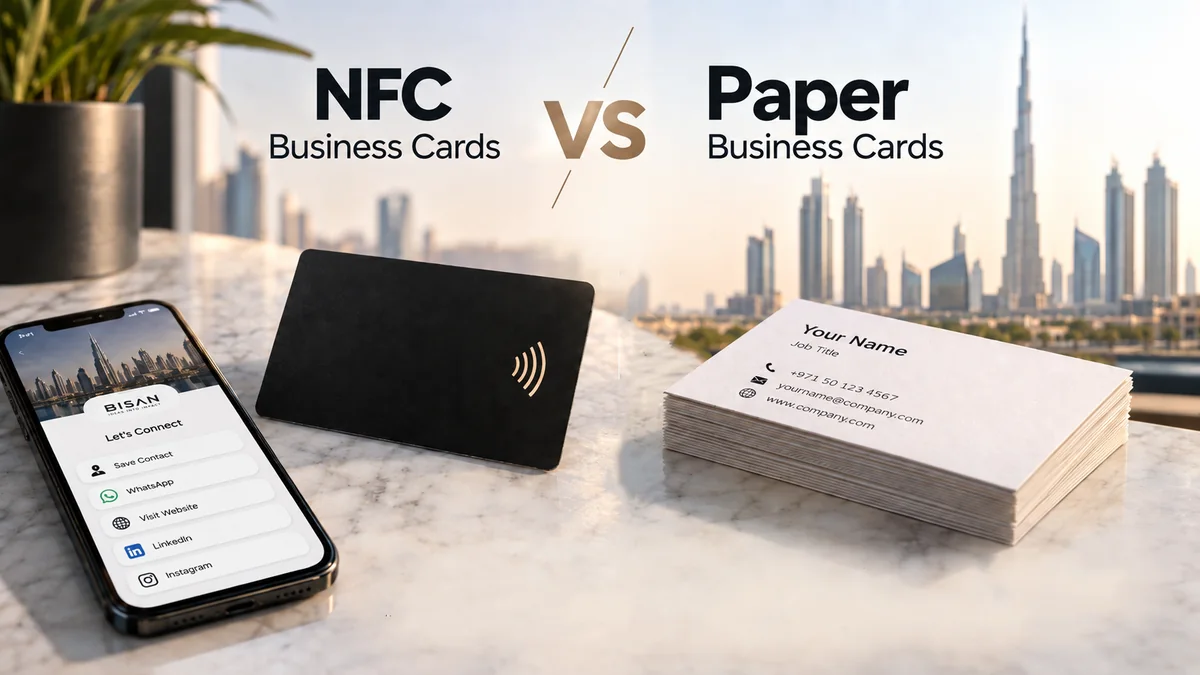
Business cards have been part of professional networking for decades. You meet someone, exchange cards, put the card in your pocket — and sometimes forget about it a few days later.
The way we connect has changed, though.
Today, people expect information to be available instantly. They want to save a phone number, open a website, visit a LinkedIn profile or start a WhatsApp conversation without manually typing everything into their phone.
That is where the NFC business card comes in.
Instead of simply giving someone your contact details on a piece of paper, an NFC card connects the physical interaction directly to your digital presence.
But does that mean traditional business cards are no longer useful?
Not necessarily.
When comparing NFC vs paper business cards, the better choice depends on how you network, what information you want to share and how you want people to interact with your brand.
What Is an NFC Business Card?
An NFC business card looks similar to a normal physical business card, but it contains a small NFC chip.
NFC stands for Near Field Communication. It is a short-range wireless technology that allows compatible devices to exchange information when they are brought close together.
When someone taps an NFC business card against a compatible smartphone, the card can instantly direct them to a digital profile, website or landing page.
Instead of asking someone to manually type your details later, you can give them immediate access during the conversation.
For most modern smartphones, there is no separate app that the recipient needs to install.
One tap is enough.
How Do Traditional Paper Business Cards Work?
Paper business cards keep things simple.
Your name, company, position and contact details are printed directly on the card. You hand it to someone, and they keep it for later.
That simplicity is one of the reasons paper business cards are still widely used.
They are particularly useful at exhibitions, conferences and large networking events where businesses may want to distribute hundreds of cards.
But there is one major limitation.
The card itself cannot do anything beyond displaying information.
If someone wants to visit your website, message you on WhatsApp or save your phone number, they usually have to take another step.
And every additional step creates another opportunity for the connection to be forgotten.
NFC Business Cards Make Networking Faster
Imagine meeting a potential client at a business event in Dubai.
With a traditional card, you hand them the card and hope they contact you later.
With an NFC card, you can ask them to tap it with their phone.
Your digital profile appears immediately.
That changes the business card from something people simply receive into something they can immediately interact with.
For salespeople, consultants, entrepreneurs, real estate professionals and anyone who regularly meets potential clients, that difference can be valuable.
Hand someone your card. They tap it. You are already connected.
Custom PVC NFC Business Card, designed around your branding, programmed and tested before it reaches you.
Your Information Can Change Without Reprinting the Card
One of the biggest disadvantages of traditional paper cards is that the information is permanent.
The cards you already printed may immediately become outdated.
You either continue distributing incorrect information or throw them away and order another batch.
With an NFC card linked to an editable digital profile or webpage, the physical card can stay the same while the information behind it changes.
That makes it much more flexible for growing businesses.
The same card may continue working even as your digital presence evolves.
One NFC Card Can Be Used Again and Again
Paper business cards are designed to be given away.
If you attend enough meetings, eventually you need another box.
An NFC card works differently.
The person you meet does not necessarily need to take the card with them.
They tap it, save your information and hand it back.
You can then use the same card during your next meeting.
And the meeting after that.
This makes an NFC card particularly useful for daily networking, sales appointments and one-to-one business meetings.
It does not mean paper cards are useless.
If you are exhibiting at a trade show and hundreds of visitors pass your booth, handing out physical cards may still be more practical.
But if most of your networking happens through direct conversations, carrying one reusable NFC card can be much more convenient.
NFC Cards Can Share Much More Information
A standard business card is small.
There is only so much information you can place on it before the design becomes crowded.
Trying to include everything often creates a card that is difficult to read.
An NFC business card does not have the same limitation.
The physical design can remain clean and minimal while the digital destination contains much more information.
Website
Send people directly to your company website instead of asking them to search for it later.
Allow potential clients to start a conversation immediately.
Social Media
Connect people to your LinkedIn, Instagram or other business profiles.
Portfolio
Designers, photographers, agencies, architects, consultants and other professionals can provide direct access to their work.
Contact Details
Give people an easy way to save your phone number, email and other information.
Location
Businesses with physical offices, clinics, salons, restaurants or retail locations can provide a direct location link.
The business card becomes less about how much information can fit on a small piece of plastic and more about giving people a convenient route to the information they actually need.
NFC vs Paper Business Cards: Cost
At first glance, paper cards may appear cheaper.
A batch of printed cards can often be produced at a relatively low cost per card.
But the comparison changes when you consider how they are used.
Paper cards are disposable.
Every person you meet receives one, and eventually you need to print more.
There may also be another printing cost whenever your information changes.
An NFC card usually costs more than a single paper card, but it is designed to be reused.
So the real question is not:
Which individual card costs less?
It is:
How many times will you use it?
For someone who attends one exhibition a year and wants to distribute 1,000 cards, traditional cards can still make sense.
For someone who attends meetings every week, the economics of a reusable NFC card may be very different.
AED 99 once, instead of reprinting every time something changes.
We design it around your identity, print it on durable PVC, programme the chip and test it before delivery.
What About Branding and First Impressions?
A business card does more than share a phone number.
It represents your business.
The material, typography, colors, layout and overall presentation all influence the impression someone gets from your brand.
That is true for both traditional and NFC cards.
A badly designed NFC card does not automatically become impressive because it contains technology.
And a beautifully designed paper card can still create a strong impression.
The strongest option combines useful technology with good branding.
A clean PVC NFC card, designed around an existing visual identity, can feel professional while keeping the experience simple.
The technology should support the brand, not become the entire brand.
This is particularly relevant in a business environment such as Dubai, where networking, personal presentation and professional relationships are often closely connected.
NFC vs Paper Business Cards: Quick Comparison
| Feature | NFC Business Card | Paper Business Card |
|---|---|---|
| Reusable | Yes | No |
| Information can be updated | Yes, depending on setup | No |
| Opens digital profiles instantly | Yes | No |
| Website access | One tap | Usually requires typing or QR |
| WhatsApp access | One tap | Usually manual |
| Social media access | One tap | Usually manual |
| Amount of information | Extensive | Limited |
| Works without a smartphone | Limited | Yes |
| Suitable for mass distribution | Less practical | Very practical |
| Requires regular reprinting | Usually no | Yes |
| Modern interactive experience | Yes | Limited |
Your card, your branding, programmed and ready to tap.
Send us your logo, your details and the link you want it to open. We handle the design, the printing and the chip.
Are NFC Business Cards Better for the Environment?
There is another difference worth considering: how many physical cards you use.
Traditional networking can involve printing hundreds or thousands of cards, many of which may eventually be thrown away.
A reusable NFC card reduces the need to repeatedly distribute individual physical cards.
That does not automatically make every NFC card environmentally superior because materials, manufacturing and electronics also have an environmental impact.
But from a usage perspective, one reusable card can significantly reduce the number of disposable business cards a professional needs over time.
Are Paper Business Cards Becoming Obsolete?
Probably not.
Paper business cards still solve a very simple problem effectively.
They are cheap to distribute, easy to understand and require no technology.
NFC cards are stronger when the interaction is more personal.
The two formats do not necessarily have to compete.
Some professionals use both.
They carry an NFC card for direct meetings and keep traditional cards available when someone wants a physical copy.
What About QR Codes?
There is also a middle ground between traditional cards and NFC technology.
A paper or PVC card can include a QR code.
The recipient opens their camera, scans the code and reaches a digital profile.
The end result can be similar to NFC.
The difference is mainly in the interaction.
With NFC:
Tap the card.
With QR:
Open the camera → point at the code → tap the notification.
It is a small difference, but when the goal is to make networking as frictionless as possible, small differences matter.
Many smart business cards can also combine both NFC and QR technology, giving the recipient more than one way to connect.
Should You Completely Replace Paper Business Cards?
For many people, there is no need to make an absolute choice.
Think about how you actually network.
If you regularly give away hundreds of cards, paper may still be useful.
If you mostly meet people individually, an NFC card may be much more practical.
If your contact information changes regularly, NFC becomes more attractive.
If your brand relies heavily on your website, social media, portfolio or WhatsApp, NFC can also make those channels much easier to reach.
The best business card is not necessarily the one with the newest technology.
It is the one that removes friction between meeting someone and staying connected with them.
Frequently Asked Questions
Are NFC business cards better than paper business cards?
NFC business cards can be better for professionals who network frequently because they are reusable and can provide instant access to contact details, websites, WhatsApp and social media. Paper business cards remain useful when large numbers of physical cards need to be distributed.
Do NFC business cards work with all smartphones?
Most modern smartphones support NFC, although compatibility and the position of the NFC reader vary between devices. Adding a QR code can provide an alternative for devices where NFC is unavailable or disabled.
Do people need an app to use an NFC business card?
Usually not. A compatible smartphone can detect the NFC card and open the programmed link through the phone’s browser without requiring a dedicated app.
Can I change my information after creating an NFC card?
Yes, if the card points to an editable digital profile or webpage. Your contact details and links can then be updated without replacing the physical NFC card.
What can I put on an NFC business card?
An NFC card can connect people to almost any web-based destination, including your website, WhatsApp, LinkedIn, Instagram, portfolio, contact page or digital business profile.
Are NFC business cards safe?
An NFC business card normally shares only the information or web link that has been intentionally programmed into it. Users still choose whether to open the information presented by their phone.
Can an NFC card also have a QR code?
Yes. Combining NFC with a QR code gives users two ways to access your digital information and can improve compatibility across different devices.
How much is an NFC business card in Dubai?
Prices depend on the card material, design, setup and provider. At Bisan, our custom NFC Business Card is AED 99 in PVC and AED 230 in stainless steel.
The Future of Business Cards Is More Connected
Business cards used to have one job: tell people how to contact you.
Today, they can do much more.
An NFC business card connects an offline conversation directly to your digital presence.
All accessible within seconds.
Traditional paper business cards still have their place, particularly when mass distribution is important. But for professionals who want networking to lead more quickly to a digital connection, NFC offers a simple alternative.
At Bisan Marketing Management, we create custom PVC and stainless-steel NFC Business Cards in Dubai for businesses and professionals across the UAE.
Our NFC business cards are AED 99 in PVC and AED 230 in stainless steel, and are typically ready within 2 working days.
One card. One tap. Everything they need to connect with you.

Discussion & Insights
Loading...